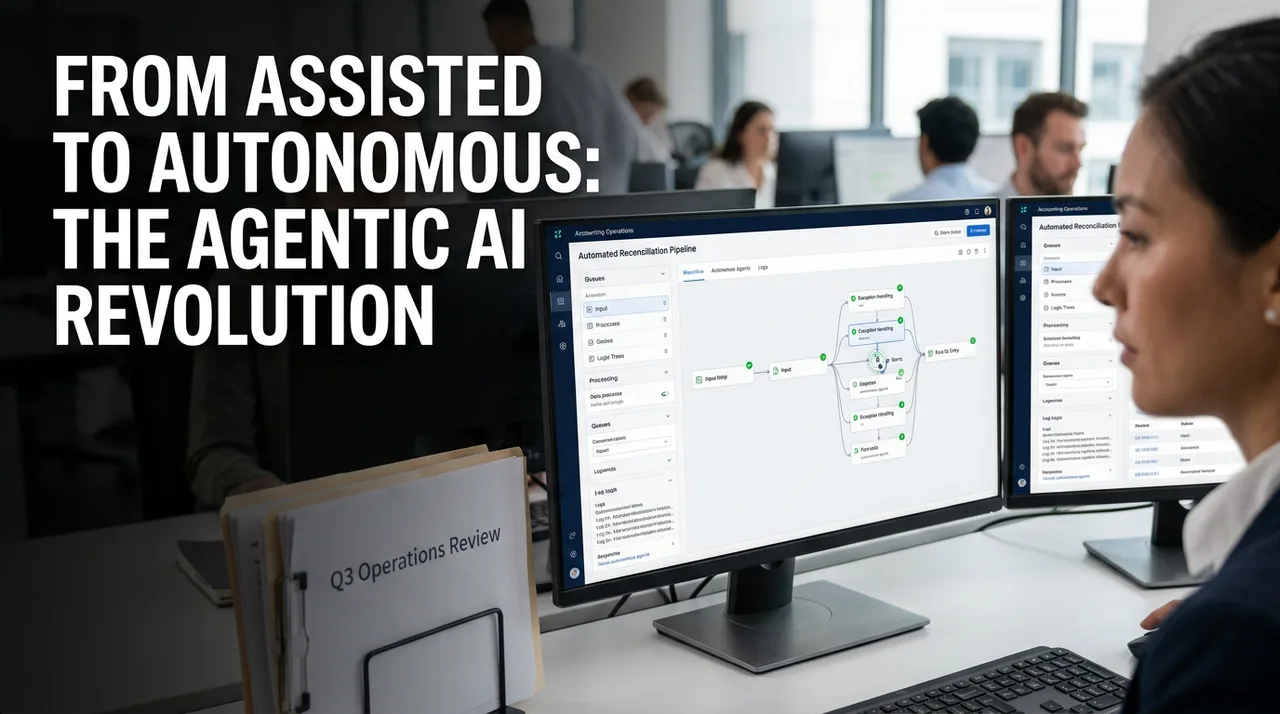
For the past few years, AI has mostly waited for a prompt. You asked, it answered, and you did the rest. That's changing fast. AI agents can now plan a task, use connected tools and apps, take action, check their own work, and keep going until the job is done, and the software businesses already use is building them in. Open standards like the Model Context Protocol (MCP) let agents connect directly to email, files, and business systems, and Gartner forecasts that by 2028, 15% of daily accounting decisions will be made autonomously by AI agents. This session explains what agentic AI is, how it works, and what it means for the way accounting and business teams get work done. This session is about understanding agents well enough to put them to work responsibly. You'll see how an agent differs from the chat assistants and automations you already know, watch agents plan and carry out multi-step work, and learn which tasks are good candidates for agents and which aren't. Just as important, you'll learn how to keep people in charge: what agents should be allowed to access, where a human must approve, and how to start with a small, low-risk pilot. You'll leave knowing where agents fit in your organization and how to take the first step safely.
Accounting and finance professionals, firm leaders, and operations managers who've moved past basic AI prompts and want to implement autonomous workflows.
No. This is a basic level course designed for accounting and finance professionals who want to understand how AI agents work and where to use them, not write the code themselves.
Standard automation follows rigid rules you set in advance, while agents can plan their own steps and use connected tools to complete a task. We'll look at how agents check their own work and adapt when a task changes.
Yes. We cover how to evaluate risks like data access and errors, and you'll learn how to select oversight controls to keep people in charge of the process.
The Model Context Protocol, or MCP, is an open standard that lets AI agents connect directly to business systems, files, and email. You'll learn how it serves as the bridge between an agent's planning and its ability to take action.
Yes. There are no prerequisites. We start by explaining how agents differ from the chat assistants you may already use, then build from there.
I spent years watching people get stuck in the cycle of constant prompting and manual copy-pasting between their apps. I wrote this course because the jump from a chatbot that answers questions to an agent that actually works through your to-do list is one of the biggest shifts I've seen in workplace technology. You deserve to understand how these systems make decisions before they start handling your data.
Reach out for more information or to bring this training to your organization.
Interested in bringing this training to your team, or want more information? Send a note and we’ll get back to you.